

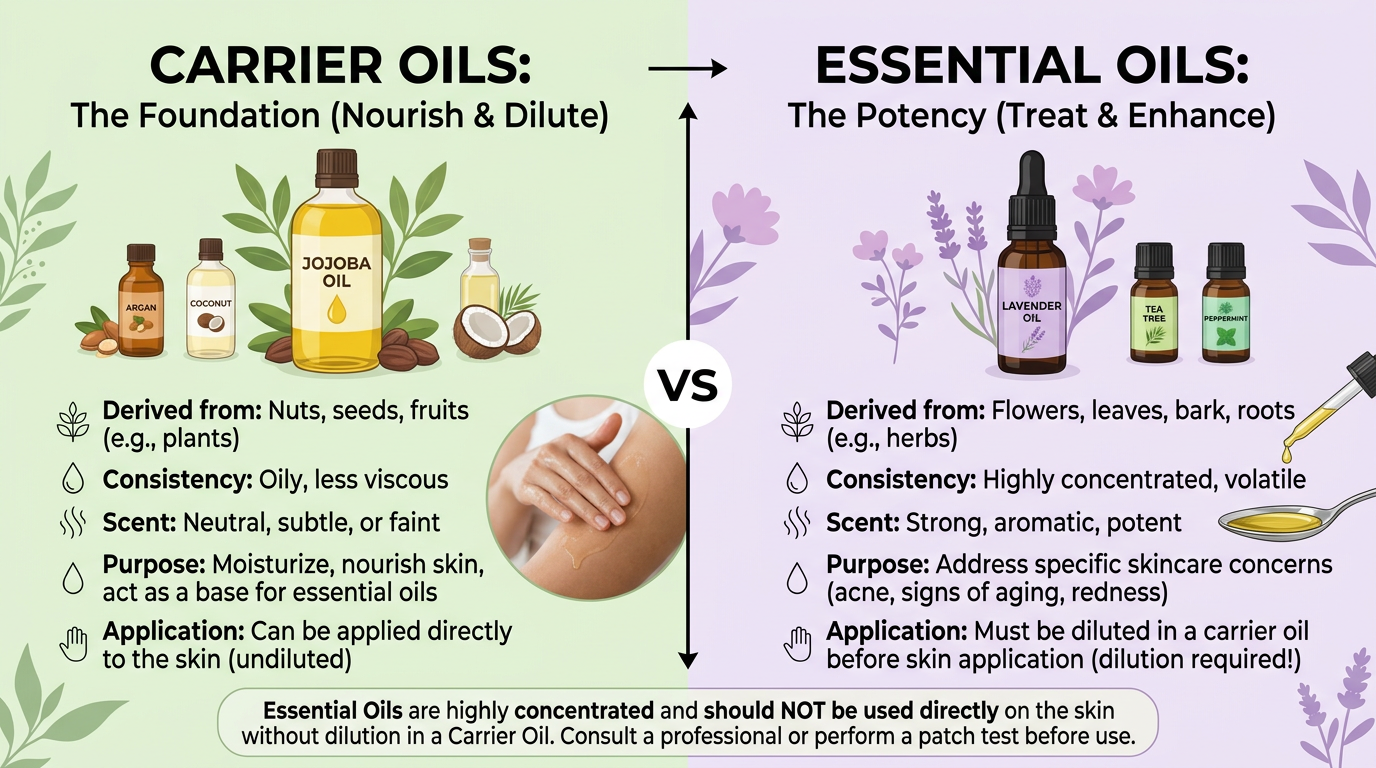
Have you ever added a few drops of a tea tree or lavender extract directly to your face, only to end up with a sudden burning sensation, bright red flushing, or peeling skin? If so, you are not alone. One of the most common mistakes skincare beginners make is confusing carrier oils and essential oils. While both come from plants, using them interchangeably can mean the difference between a deeply hydrated skin barrier and a painful chemical burn.
So, what is the difference between carrier oils and essential oils, and how do you use them safely? Think of a carrier oil as your skin’s daily nourishing meal—a rich, fatty lipid that seals in moisture and protects your skin wall. An essential oil, on the other hand, is like a double shot of espresso—a hyper-concentrated botanical extract that must always be diluted before touching your skin. In this beginner-friendly guide on Carrier Oils vs. Essential Oils: Differences, Safety & Dilution Guide, we break down how both plant oils work, explain why raw essential oils burn, share an easy-to-read dilution cheat sheet, and help you pick the best oils for your specific skin type.
1. Lipid Mechanics: Fatty Acids vs. Volatile Terpenes
To understand why carrier oils and essential oils behave so differently on your skin, it helps to look at where they come from and how they are made. They belong to two completely different chemical families:
-
1. Carrier Oils (Fixed Fatty Acid Oils — Your Skin’s Protective Mortar):
Carrier oils are cold-pressed directly from the fat-rich seeds, nuts, or kernels of plants (like jojoba seeds, rosehip seeds, or argan nuts). They are packed with essential fatty acids (like Oleic and Linoleic acid), skin-identical triglycerides, and Vitamin E. Because they are “fixed” oils, they do not evaporate into the air when you open the bottle. Instead, they sit comfortably on your skin, filling in microscopic cracks to lock in hydration and stop water loss. -
2. Essential Oils (Volatile Aromatic Compounds — Concentrated Plant Essences):
Essential oils are steam-distilled or cold-pressed from plant leaves, bark, roots, or flower petals (like lavender, peppermint, or tea tree). They contain zero fatty acids and offer no moisturizing benefits. Instead, they are made of tiny, highly volatile molecules called terpenes and phenols that evaporate rapidly into the air—which is why they smell so strong! Because they are extremely concentrated, applying them straight to your skin without a carrier oil causes severe irritation.
Understanding this biological difference explains why you need a carrier oil to dilute essential oils: the thick fatty acids in carrier oils act as a gentle cushion, carrying the strong aromatic compounds onto your skin safely without triggering an allergic reaction or burning your moisture barrier. To learn how fatty acids protect your skin shield, read our foundational guide on how to repair a damaged skin barrier.
2. Head-to-Head Comparison: Carrier Oils vs. Essential Oils
Compare the core clinical properties, application safety, and primary functions across both plant oil categories:
| Feature | Carrier Oils (Base / Fixed Oils) | Essential Oils (Aromatic Extracts) |
|---|---|---|
| Primary Source | Pressed from nuts, seeds & fruit kernels | Steam-distilled from leaves, stems & flowers |
| Chemical Profile | Rich in fatty acids, triglycerides & Vitamin E | Volatile aromatic terpenes, phenols & aldehydes |
| Direct Application? | Yes (100% safe to apply directly to skin) | No (Must ALWAYS be diluted in a carrier oil) |
| Main Function | Moisturizes, seals water & repairs skin barrier | Aromatherapy, targeted active properties & scent |
| Evaporation Rate | Fixed (Stays on skin to build protective seal) | Volatile (Evaporates rapidly upon exposure to air) |
| Risk of Irritation | Very Low (Nourishing lipid compatibility) | High (Potential for contact burns & allergies) |
3. Carrier Oils: The Lipid Mortar & Barrier Protectors
Carrier oils derive their name from their primary functional role: they “carry” concentrated active ingredients or essential oils safely into the skin without triggering irritation. However, high-quality carrier oils are skin-healing powerhouses on their own.
Because carrier oils mirror the natural lipids produced by your skin’s sebaceous glands, they fill in microscopic cracks in your stratum corneum, stop Transepidermal Water Loss (TEWL), and restore elasticity. If your skin barrier is currently raw or stinging from active overuse, read our 14-Day Over-Exfoliated Skin Recovery Protocol and foundational guide on how to repair a damaged skin barrier.
Popular carrier oils include Jojoba, Squalane, Rosehip, Argan, and Marula oil. Learn how to choose between top plant lipids in our guides on Squalane vs. Jojoba Oil, Rosehip Oil vs. Argan Oil, and our master Facial Oil vs. Moisturizer Guide.
4. Essential Oils: High-Potency Botanical Extracts & Risks
Essential oils (such as Tea Tree, Lavender, Eucalyptus, Rosemary, and Peppermint) are extremely concentrated. For example, it takes roughly 220 pounds of lavender flowers to yield just one pound of lavender essential oil!
Because of this extreme concentration, applying undiluted essential oils directly to your face can strip your natural skin lipids and cause severe contact dermatitis. Common signs of essential oil irritation include sudden burning, red flushing, tiny blistering bumps, and severe flaking. If you have sensitive, reactive, or eczema-prone skin, dermatologists recommend avoiding facial essential oils entirely and focusing on pure soothing barrier ingredients like Panthenol and Centella Asiatica (Cica). Read our Master Panthenol Guide and Master Centella Asiatica Guide.
5. Safe Dilution Guide: How to Dilute Essential Oils Safely
If you enjoy mixing your own natural body oils, scalp drops, or bath blends, following safe dilution ratios is the single most important rule. Think of essential oils like concentrated hot sauce—a tiny drop adds flavor, but pouring it straight onto your face will burn!
Golden Rule: Never apply undiluted essential oils directly to your skin. Always mix them into a fatty carrier oil (like Jojoba, Squalane, or Argan oil) first.
Use these simple, dermatologist-approved recipes when blending your oils at home:
-
0.5% Dilution (Gentlest — For Facial Care & Sensitive Skin):
• Recipe: 3 drops of essential oil per 1 ounce (30 ml or 2 tablespoons) of carrier oil.
• Best for: Subtle facial oils, eye-area care, or very sensitive skin profiles. -
1.0% Dilution (Mild — For Daily Body Oils & Scalp Serums):
• Recipe: 6 drops of essential oil per 1 ounce (30 ml or 2 tablespoons) of carrier oil.
• Best for: Daily moisturizing body lotions, hand oils, and hair/scalp treatments. -
2.0% Dilution (Moderate — For Targeted Body Massage):
• Recipe: 12 drops of essential oil per 1 ounce (30 ml or 2 tablespoons) of carrier oil.
• Best for: Temporary foot rubs, muscle massage oils, or short-term spot application. - Quick Patch Test Rule: Before applying any new oil blend to your face or body, dab a dime-sized amount on your inner forearm and wait 24 hours. If you see redness, itching, or bumps, wash it off and skip that essential oil!
For a full visual breakdown of plant oils vs. aromatic essences in skincare, we recommend watching: “Dermatologist Explains Carrier Oils vs Essential Oils for Skin Barrier Health” on YouTube. Search for video breakdowns by Dr. Dray or Lab Muffin Beauty Science to see formulation science in action!
6. How to Choose the Right Carrier Oil for Your Skin Type
Not all carrier oils feel or act the same on your skin. Choosing the best carrier oil comes down to understanding two simple factors: Comedogenic Rating (pore-clogging potential) and Fatty Acid Ratio (lightweight vs. rich).
Think of plant fatty acids like weather coats: Linoleic Acid is a light, breathable windbreaker for oily skin, while Oleic Acid is a thick, cozy winter parka for dry skin.
✨ Best for Oily, Combination & Acne-Prone Skin
Look for lightweight carrier oils high in Linoleic Acid with a low Comedogenic Rating (0 to 1). These oils balance excess shine, absorb quickly, and won’t clog your pores:
- Squalane Oil (Comedogenic Rating: 0): A featherlight oil that mimics your skin’s natural sebum. Read Squalane vs. Jojoba Oil.
- Jojoba Oil (Comedogenic Rating: 2): Technically a liquid wax ester that trickles into pores to trick skin into producing less oil.
- Rosehip Seed Oil (Comedogenic Rating: 1): Packed with pro-Vitamin A to brighten post-acne marks. Read Rosehip Oil vs. Argan Oil.
💧 Best for Dry, Mature & Sensitive Skin Barriers
Look for rich carrier oils high in Oleic Acid. These deep-penetrating lipids restore lost flexibility and prevent overnight water loss:
- Argan Oil (Comedogenic Rating: 0): Packed with Vitamin E to soothe red, peeling, or dry skin. Read Rosehip Oil vs. Argan Oil.
- Marula Oil (Comedogenic Rating: 3–4): A rich, cushiony oil that locks in deep hydration for dry, aging skin.
- Overnight Barrier Seal: Apply 2 drops of carrier oil over a ceramide night cream. Read our guide on what is a night cream and why you need one.
7. Pros & Cons: What We Like vs. Consider
When incorporating plant oils into your daily routine, understanding the strengths and risks of both categories helps you protect your skin barrier while enjoying botanical skincare:
What We Like (Pros)
- Instant Barrier Protection: Carrier oils rebuild lost surface lipids, sealing in moisture and stopping dryness in its tracks.
- Zero Chemical Burn Risk: Pure, cold-pressed carrier oils are 100% safe to apply directly to raw, sensitive, or over-exfoliated skin.
- Therapeutic Aromatherapy: Diluted essential oils offer natural scents and targeted antimicrobial benefits for body care and scalp treatments.
- Customizable Skincare: Carrier oils allow you to safely blend custom body lotions, bath oils, and massage treatments at home.
Things to Consider (Cons)
- Severe Irritation Risk: Applying essential oils undiluted directly to skin can trigger contact dermatitis, stinging, and chemical burns.
- Photosensitivity Warnings: Citrus essential oils (like Lemon, Lime, or Bergamot) can cause severe sun blistering if exposed to daylight.
- Pore-Clogging Potential: Heavy carrier oils high in oleic acid (like coconut or wheat germ oil) can trigger breakouts on acne-prone skin profiles.
Amazon Prime 30-Day Free Trial
or sign up for the
Prime Young Adult 6-Month Trial
if you’re a student!
8. Frequently Asked Questions (FAQs)
No, never! Applying neat (undiluted) essential oils directly to your face or body can cause allergic contact dermatitis, severe red flushing, stinging, and chemical burns. Essential oils must always be diluted in a fatty carrier oil (like Jojoba, Squalane, or Argan) to cushion your skin barrier.
Do not try to wash it off with water! Essential oils are lipophilic (oil-soluble), meaning water will actually spread the burning oil across your skin. Instead, immediately pour a plain carrier oil (like Jojoba, Olive, or Coconut oil) onto a cotton pad and wipe the area gently to dissolve the essential oil, then wash with a gentle milk cleanser.
Applying pure 100% Tea Tree Essential Oil directly to a pimple often burns the surrounding healthy skin, leaving a dark hyperpigmentation mark. Always dilute Tea Tree oil down to a 0.5% or 1% concentration in a lightweight carrier oil like Squalane before spot treating.
Coconut Oil is a carrier oil! It is pressed from the fatty meat of the coconut and contains rich fatty acids (like Lauric acid). However, because unrefined coconut oil is highly comedogenic (pore-clogging rating of 4 out of 5), it is best reserved for body lotions and hair treatments rather than facial application.
Squalane Oil and Jojoba Oil are the top choices. Both are non-comedogenic, mimic human natural sebum, and seal in moisture without triggering stinging or breakouts on raw, sensitive skin barriers.
9. Final Takeaway: Safe Botanical Skincare Practices
Mastering the difference between carrier oils and essential oils is fundamental to keeping your skin healthy, calm, and resilient. Reach for nourishing carrier oils (like Squalane, Jojoba, or Rosehip) as a daily step to lock in deep moisture, heal micro-cracks, and seal your evening night cream. Treat essential oils with care—reserving them for aromatherapy or diluting them strictly according to safe measurement ratios in body formulations!
- Carrier Oils = Base Moisture: Fatty acid oils (Jojoba, Squalane, Argan) that repair the barrier, lock in hydration, and carry active ingredients safely.
- Essential Oils = Aromatic Extracts: Concentrated plant compounds that must ALWAYS be diluted in a carrier oil (0.5% to 1.0% for face and body).
- Emergency First Aid: If essential oils sting your face, wipe them away with a plain carrier oil—never plain water!
- Barrier Rule: Skip essential oils entirely on facial skin if your moisture barrier is red, raw, or over-exfoliated.
To explore more gentle cleansing and body care guides, read our master body wash guide, review gentle cleansers in our Cetaphil Ultra Gentle Body Wash review, or learn about body hyperpigmentation in Kojic Acid Soap vs. Body Wash.
Leave a Reply