

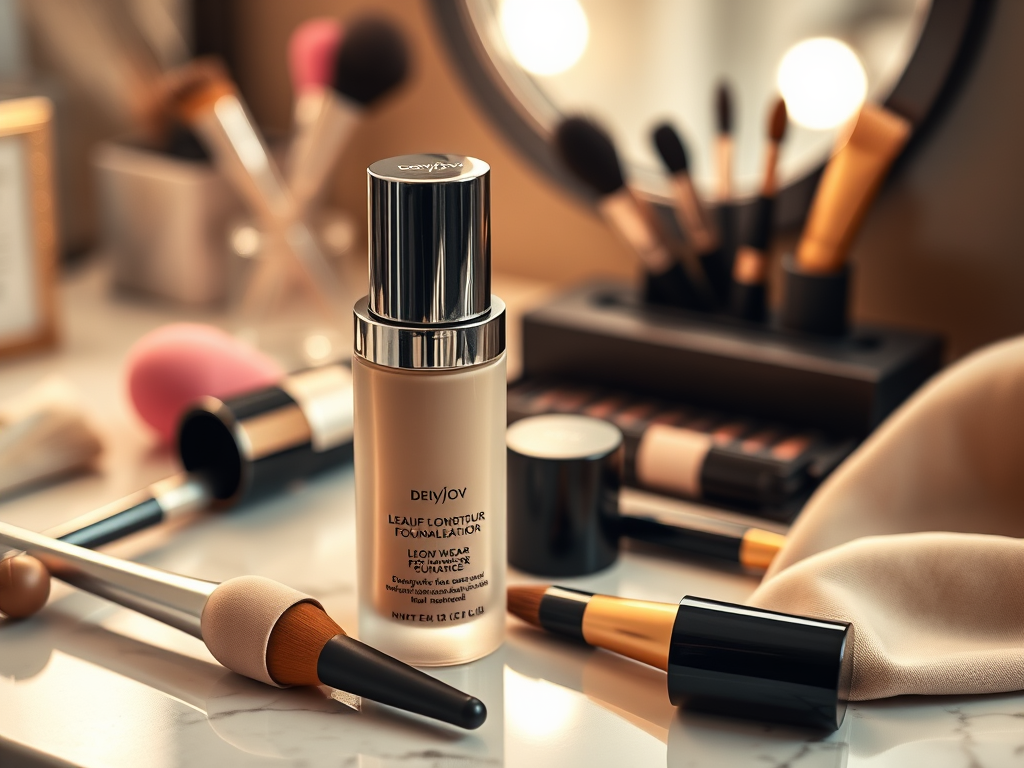
Finding a high-performance foundation that successfully survives humidity, sweat, and midday oil production requires looking past simple shade matching. We’ve all been there: you apply what promises to be a “16-hour bulletproof formula,” only to look in the mirror four hours later to find it cracking around your mouth, separating on your nose, or clinging to dry patches.
The secret to stopping this breakdown isn’t buying a more expensive bottle—it’s understanding that long-wear makeup behaves completely differently than standard cosmetic formulas.
Unlike standard dewy liquids that remain fluid and mobile on your face, a true long-wear foundation relies on a rapid, calculated chemical transition. Think of it like a high-tech paint: from the moment the liquid leaves the bottle, a countdown begins as temporary liquid carriers evaporate, leaving behind a micro-thin, immovable shield of pure pigment.
If you manage this short setting window incorrectly by dotting it all over your face at once, the formula locks down prematurely—instantly looking patchy, heavy, and mask-like.
This guide translates the science of cosmetic chemistry into simple, actionable mechanical rules. You will learn the exact 90-second blending window, how to sheer it down for natural daily wear, and how your choice of tools alters the finish.
Table of Contents
- The Volatilization Phase: The Science of the “Dry-Down”
- Pigment Density & The Everyday “Sheer-Down” Hack
- The Working Window: Mechanical Application Rules
- Brush vs. Sponge: How Your Tools Change the Makeup Matrix
- High-Performance Formulations: The Technical Matrix
- Long-Wear Dynamics: Frequently Asked Questions
- The Final Takeaway: Think Like a Pro
1. The Volatilization Phase: The Science of the “Dry-Down”
The fluid, silky glide you feel when first applying a high-end long-wear foundation is made possible by temporary liquid ingredients called volatile solvents (most commonly Isododecane and lightweight silicones). These ingredients serve a single, crucial purpose: they keep the makeup wet and workable just long enough for you to blend it smoothly over your skin.
However, within 60 to 90 seconds of hitting your warm face, these temporary liquids turn into vapor and rapidly evaporate. As they disappear, the remaining setting agents undergo a fast phase change—shrinking, tightening, and locking the makeup into place.
⚠️ Takeaway: This rapid “dry-down” is what makes the foundation completely transfer-proof, but it also means your blending clock is ticking. If you don’t blend it out immediately, it will lock into place exactly where it is, causing instant patchiness.
2. Pigment Density & The Everyday “Sheer-Down” Hack
A very common mistake when using long-wear makeup is applying a thick layer because you assume you need it for heavy coverage. In reality, modern performance foundations achieve their intense coverage through high pigment loading. This means they contain a much higher percentage of micro-fine color particles per drop than sheer, dewy tints.
Because the color density is so concentrated, a single micro-drop provides full physical coverage.
💡 Takeaway: The thinner the layer of makeup on your face, the less likely it is to shift, crack, or separate when you smile, talk, and move your facial muscles. To avoid the dreaded “cakey mask” look, use half the amount you normally would.
🛠️ The Everyday Dilution Method
Because these formulas are packed with pigment, you do not have to wear them at full, heavy coverage for your daily morning routine. You can easily adjust the formula for a fresh, everyday look:
- The Tinted Moisturizer Hack: Mix 1 drop of your long-wear foundation with 2 drops of your favorite daily gel moisturizer or a lightweight hyaluronic acid serum on the back of your hand before applying.
- The Result: By diluting the concentration, you keep the incredible, transfer-proof staying power of the volatile solvent base, but you transform the finish into a breathable, sheer daily tint that looks like real skin.
3. The Working Window: Mechanical Application Rules
Because the chemical dry-down happens so quickly, the classic technique of dotting foundation all over your forehead, cheeks, and chin before blending will guarantee a makeup disaster. The dots will dry out and lock down before your brush even reaches them, leading to obvious streaks.
To work with the fast-drying chemistry instead of against it, follow these two essential golden rules:
Rule 1: The One-Zone-at-a-Time Method
Never apply the product to your entire face at once. Instead, work in isolated sections. Complete one cheek entirely—dots, blending, and smoothing—before moving to your jaw, nose, and forehead. This guarantees you are actively moving the formula while the liquid carriers are still wet and flexible.
Rule 2: Wait for Your Skincare to Dry
Applying fast-setting makeup directly on top of wet, unabsorbed face oils or heavy moisturizers is a recipe for immediate sliding. The wet skincare prevents the foundation’s setting shield from properly gripping your skin cells. Always wait 3 to 5 minutes for your skincare to fully sink in before going in with your foundation base.
- Struggling with dry skin prep? Learn the exact daytime prep sequence in our guide on [how to prep dry skin for matte foundation] to prevent your base from clinging to rough patches.
4. Brush vs. Sponge: How Your Tools Change the Makeup Matrix
The final look of your long-wear foundation isn’t just decided by the ingredients inside the bottle; it depends heavily on the physical force you use to blend it out. Choosing the wrong tool can cause fast-drying makeup to bunch up and cake before it even touches your skin.
- Dense Synthetic Buffing Brushes (High Opacity): Brushes apply a high amount of direct force to the skin. The stiff bristles rapidly micro-distribute high concentrations of pigment across the natural valleys and pores of your face, giving you maximum coverage very quickly.
- The Catch: Because brushes work fast, they can agitate the surface of your skin. If you have any dry patches, aggressive buffing will micro-lift those skin flakes, making the foundation look dry and textured.
- Damp Makeup Sponges (Smoother Blend): Damp beauty sponges apply less friction and introduce a crucial secret weapon: moisture. The water held inside the damp sponge micro-delays the fast evaporation of the foundation’s liquids.
- The Benefit: This gives you a slightly wider blending window and creates a much smoother, more flexible layer of makeup. If you struggle with cakeyness, a damp sponge is your best friend. To learn more about mastering these tools, explore our full battle of the [makeup sponge vs. brush].
5. High-Performance Formulations: The Technical Matrix
To get the most out of your long-wear routine, you need to match your specific skin type to the exact chemical network inside the bottle. Three distinct formulation styles rule the market today, and you can see how they line up contextually against your current profile:
- The Rigid Silicone Standard: If you have an oily skin type or live in high humidity, look for formulas powered by Trimethylsiloxysilicate—a rigid resin suspended in a fast-evaporating fluid carrier. This technology is what gives Estée Lauder Double Wear Stay-in-Place its legendary status, as the liquid flashes off to leave an immovable, completely water-resistant crystalline grid on the face.
- The Volatile Hydrocarbon Blend: For textured or normal-to-oily skin profiles that absolutely hate the feel of heavy makeup, formulas relying on lightweight hydrocarbon carriers like Isododecane coupled with simple alcohol flash agents are ideal. A prime example is Lancôme Teint Idole Ultra Wear, which provides incredibly high pigment coverage but undergoes an instant phase change to set into an ultra-thin, completely breathable natural matte finish.
- The Alkane & Mineral Shield: If you have combination skin with large pores, you want to step away from heavy silicones entirely and look for bio-alkane bases (like Undecane). Formulations like the NARS Natural Matte Longwear Foundation use these plant-derived alkane carriers alongside structural silica microspheres, which actively absorb excess facial oils throughout the day without causing the underlying pigment matrix to crack or separate.
🛍️ Ready to see our full, field-tested list? If you want to compare prices, shade ranges, and comprehensive real-world wear tests, read our comprehensive hands-on breakdown of the [best long-wear foundations] on the market today.
6. Long-Wear Dynamics: Frequently Asked Questions
Why does my long-wear foundation turn orange after a few hours?
This is called oxidation. It happens when the high concentration of metal oxides (the ingredients that give the foundation its color) interacts with your skin’s natural oils or the air as the liquid evaporates. To stop this chemical reaction, apply a lightweight, silicone-based primer before your foundation. This creates a clean physical barrier between your skin’s oils and the makeup.
Why does my foundation separate around my nose and chin?
Separation happens when your skin produces localized excess oil that forces its way underneath the set makeup film. Because oil acts as a natural solvent, it slowly dissolves the foundation’s grip from the bottom up. Pressing a tiny amount of an oil-absorbing primer onto your oily zones before applying foundation is the easiest way to prevent this breakdown.
Do long-wear foundations clog pores and cause acne?
Not inherently, but the way they are removed often does. Because long-wear foundations rely on heavy, water-resistant polymer resins to stay in place, standard foaming cleansers cannot fully dissolve them. This leaves a micro-film of makeup, sweat, and trapped sebum inside your pores overnight, leading to breakouts.
To prevent clogged pores, always use a non-comedogenic formula and implement a double-cleanse. Using a formula from our curated list of the [best cleansing balms for waterproof makeup] will melt the stubborn polymer matrix instantly without irritating your skin barrier.
Do I really need to set a long-wear foundation with powder?
If you have normal-to-dry skin, no! True long-wear formulas completely self-set on their own once their liquid carriers evaporate, making powder totally optional. However, if you have an oily skin type, sweeping a micro-layer of translucent powder over your high-shine areas creates a safety reservoir that soaks up oils before they can reach and destroy your foundation layer.
If you want to know whether you should use a loose powder or a locking mist to seal your base, check out our full breakdown of [setting spray vs. powder].
7. The Final Takeaway: Think Like a Pro
Mastering a long-wear foundation doesn’t require professional makeup artist skills—it just requires understanding how the product behaves once it leaves the bottle. By respecting the short 90-second dry-down window, utilizing the one-zone-at-a-time method, and choosing the right tool to control mechanical shear, you can stop fighting your makeup.
Instead of dealing with mid-day cracking, sliding, or melting, you’ll have a micro-thin, resilient layer that moves with your face and stays flawless from your morning coffee to the end of the night. Flawless complexion isn’t about applying more product; it’s about applying it smarter.
Leave a Reply